Engineering expertise for complex automation systems.
Orange-Tech supports machine builders, manufacturers and technology developers with the specification, design and integration of automated equipment and systems.
From early requirements and system architecture through to detailed engineering and technical verification, we help turn challenging automation requirements into practical engineering solutions.
Commission a focused work package or bring specialist support into a wider development programme. The scope follows the technical problem.
Requirements & Functional Specification
Give the design a testable starting point.
Develop user requirements (URS), functional specifications (FDS), equipment performance requirements, operating sequences and interface requirements. Feasibility work identifies assumptions that need evidence before the specification is fixed.
Outputs you can commission
A structured requirements baseline
Functional sequences and operating behaviour
Interface requirements and acceptance criteria
In practice +
Specify what “ready” means, how a failed cycle is recovered and which conditions must be demonstrated at acceptance—not just the nominal throughput.
System Architecture & Integration
Make the subsystem boundaries explicit.
Develop automation concepts, equipment architecture and system-level functional design. Resolve how mechanical equipment, electrical infrastructure, controls and supplier systems interact, with technical support through integration.
Outputs you can commission
A system architecture and concept rationale
An interface register and integration strategy
Defined subsystem responsibilities and open technical actions
In practice +
A transfer between two machines needs agreed position, timing, data and fault behaviour. A mechanical hand-off and a controls handshake must describe the same event. For instrument interfaces, explore our laboratory automation support.
Electrical & Controls Engineering
Resolve the decisions behind the control system.
Support electrical design, control-system architecture, hardware and component specification, instrumentation, sensing and actuator interfaces. Review designs and investigate engineering issues alongside the project team.
Outputs you can commission
Electrical and controls requirements
Hardware specifications and interface definitions
Design-review findings and troubleshooting recommendations
In practice +
A sensor selection must account for the target, environment, signal behaviour and fault response. Choosing a device is only one part of defining how the system will use it.
Technical Design & Verification
Turn design intent into reviewable evidence.
Review a defined engineering scope, evaluate technical risks and plan verification. Support FAT and SAT planning, technical issue resolution, equipment integration and commissioning activities.
Outputs you can commission
Prioritised design-review findings
Verification plans and acceptance-test criteria
Technical action records and documentation reviews
In practice +
An acceptance test needs a defined configuration, method and pass criterion. An observation that a machine “ran successfully” does not demonstrate every requirement.
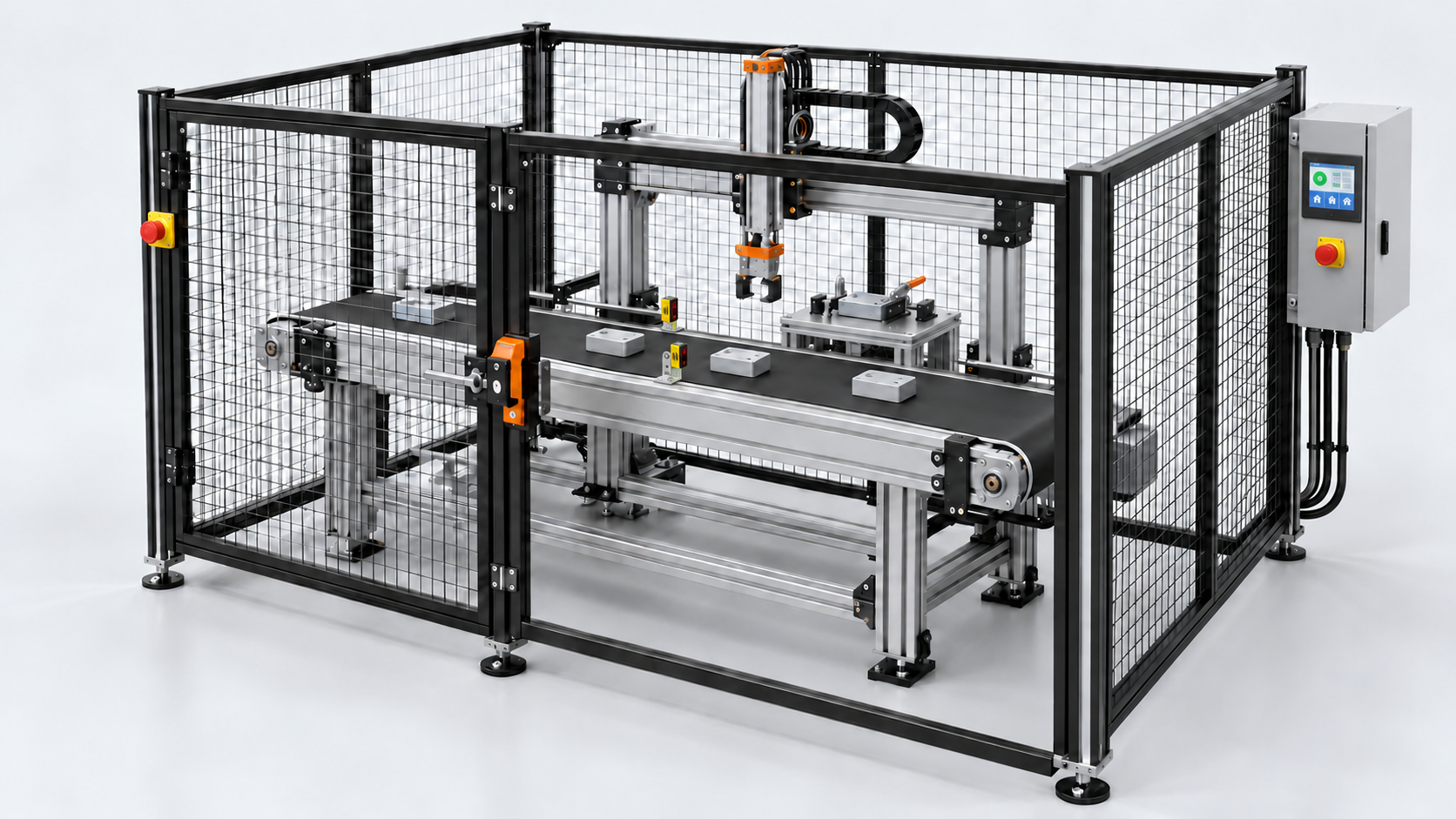
One machine. Five engineering disciplines.
Good automation is more than a collection of components. Explore the decisions that make the equipment work as a complete system.
010203
010203
010203
010203
01020304
01
ConveyorPresents components to the handling system.
02
Cartesian gantryProvides horizontal travel between pick and fixture positions.
03
Receiving fixtureLocates the component for the next operation.
Defining the mechanical solution
The conveyor and handling system must transfer components reliably to the receiving fixture. Component dimensions, payload, travel, positioning accuracy and cycle time define the equipment requirements. Motion profiles and fixture access must be considered together.
Typical engineering deliverables
Equipment concept and mechanical requirements
Motion and positioning requirements
Functional operating sequence
Equipment and actuator specifications
01
Control cabinetEncloses the electrical and control equipment.
02
Operator HMIProvides the operator interface for machine status and commands.
03
Gantry cable carrierRoutes electrical and pneumatic services along the moving axis.
Developing the control-system architecture
The conveyor, gantry, gripper and fixture require coordinated control. Define the operating sequences, motion control, instrumentation and operator interaction before selecting hardware. Electrical requirements, operating modes and subsystem interfaces establish the basis of the controls architecture.
Typical engineering deliverables
Electrical and controls requirements
Control-system architecture
Hardware and component specifications
Functional control requirements and electrical interfaces
01
Conveyor detection pointsPhotoelectric detection positions used to establish component presence.
02
Gantry sensors and actuatorsGripper and axis feedback or actuation interfaces needed for controlled movement.
03
PLC and I/O controlControl-system input and output signals are connected and interpreted through the control architecture.
Turning physical conditions into reliable information
Photoelectric sensors can confirm component presence for conveyor positioning and gantry pick sequences. Detection principle, mounting, environment and signal behaviour determine whether that information is dependable. Fixture confirmation is a requirement to define—not an assumed feature of the image. These process sensors are not identified as safety-rated protective devices.
Typical engineering deliverables
Instrumentation requirements and sensor specifications
I/O schedules
Signal and interface definitions
Functional verification criteria
01
ConveyorPresents the component for transfer.
02
GripperTransfers the component between subsystems.
03
Receiving fixtureEstablishes its position for the next operation.
Making the complete system work together
The conveyor presents a component, the gantry transfers it, and the fixture establishes its position for the next operation. Agree what “ready” means at each hand-off: part location, actuator state, sensor evidence, subsystem permissions and ownership of the transfer. Define recovery after an interrupted sequence, including missing parts, lost signals and restart conditions, then test those exceptions against agreed acceptance criteria.
Typical engineering deliverables
Functional Design Specification
System interface register and subsystem responsibilities
Operating sequence and integration strategy
Fault-handling and recovery requirements
Verification and acceptance criteria
01
Perimeter guardingSeparates personnel from the enclosed motion area.
02
Guard interlock handleAccess-door interlocking must be considered alongside the operating modes and control system.
03
Access-side emergency stopEmergency-stop demand at the guarded access side.
04
Control-cabinet emergency stopEmergency-stop demand beside the operator interface.
Integrating safety into the machine design
Access to hazardous motion, guarding, interlocking, operating modes and emergency-stop functions must inform the mechanical and controls design. Hazard identification and risk assessment establish the required safeguards and performance of safety-related control functions. Emergency stops complement safeguarding and interlocking; they do not replace them.